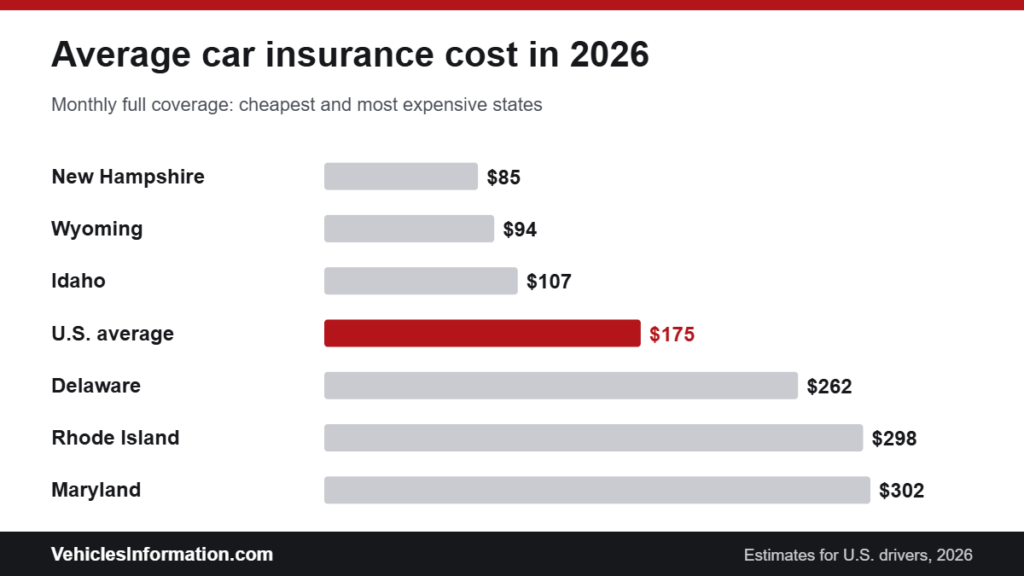
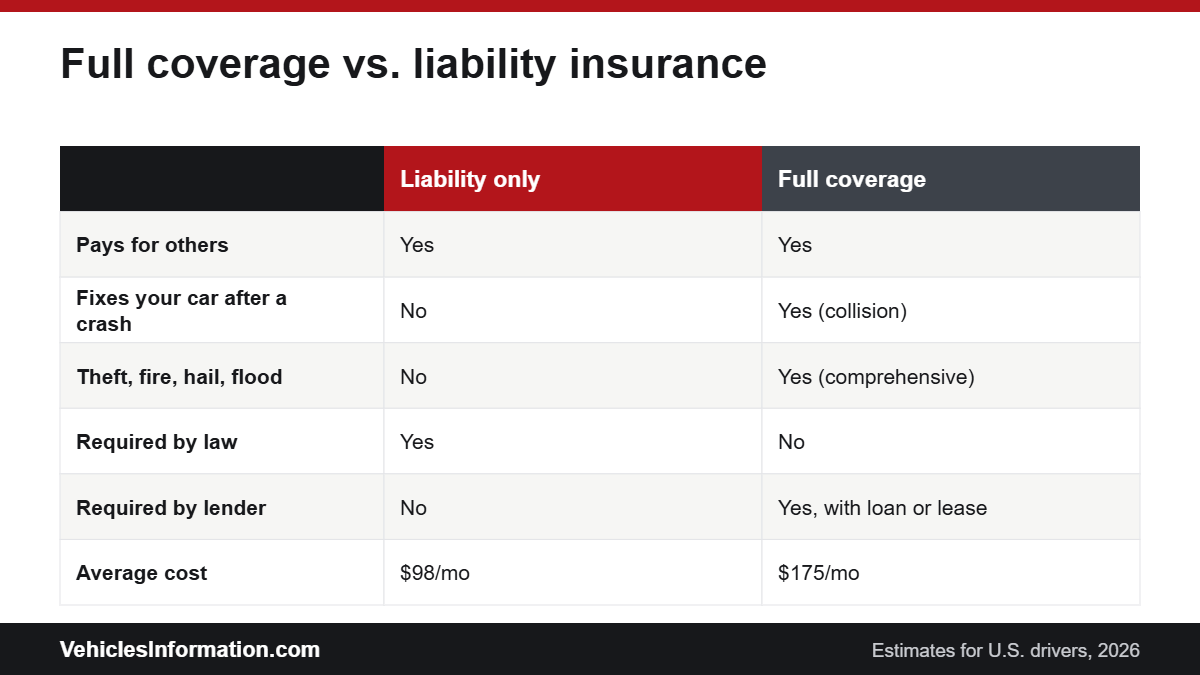
Liability insurance pays for injuries and damage you cause to other people. Full coverage is liability plus collision and comprehensive, which also pay to repair or replace your own car. Full coverage costs about $175 a month on average, compared with $98 for liability-only. You need full coverage if your car has a loan or lease, and it is usually worth it while your car is worth more than about $4,000.
See both prices for your state and age with our car insurance calculator, which compares all coverage levels side by side.
What liability insurance covers
- Bodily injury liability: medical bills, lost wages and legal costs for people you injure.
- Property damage liability: repairs to other people’s cars, fences, buildings and property.
It does not pay for your own car or your own injuries. Almost every state requires liability insurance. New Hampshire does not strictly require it but holds drivers responsible for damages.
What full coverage adds
- Collision: repairs your car after a crash with another car or an object, no matter who is at fault, minus your deductible.
- Comprehensive: pays for theft, vandalism, fire, hail, flood, falling objects and hitting an animal, minus your deductible.
Many people also add uninsured motorist cover, medical payments or personal injury protection, rental reimbursement and roadside help. These are separate add-ons, even on a “full coverage” policy.
Cost: full coverage vs. liability
| Coverage | Average monthly | Average yearly |
|---|---|---|
| State minimum liability | $83 | $1,000 |
| Liability with higher limits | $123 | $1,470 |
| Full coverage ($500 deductible) | $175 | $2,100 |
| Full coverage ($1,000 deductible) | $166 | $1,990 |
Full coverage costs roughly $77 more per month than average liability-only cover, or about $920 a year.
When you need full coverage
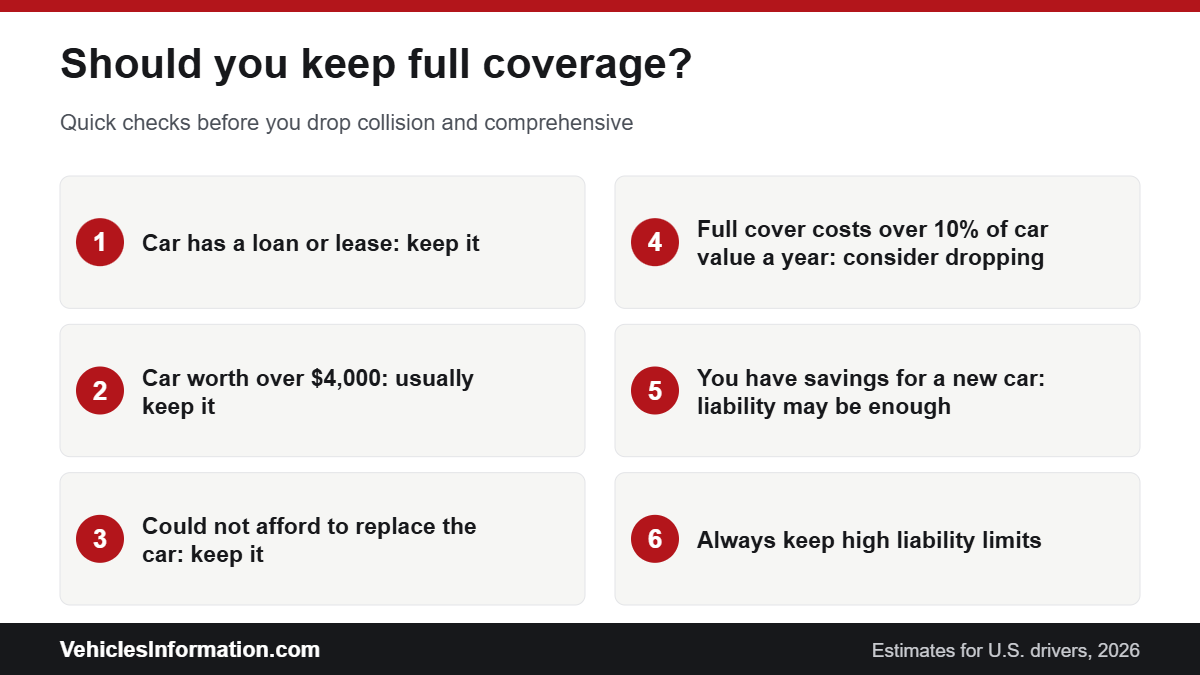
- You have a car loan or lease. The lender requires it.
- Your car is new or worth a lot.
- You could not pay for a replacement car out of savings.
- You live where theft, hail or flooding are common.
- You park on the street in a busy area.
When liability-only makes sense
- Your car is paid off and worth less than about $4,000.
- The yearly cost of collision and comprehensive is more than 10% of the car’s value.
- You have enough savings to replace the car if it were totaled.
The 10% rule
When collision and comprehensive cost more than about 10% of your car’s value each year, full coverage stops being good value. We walk through the math with examples in when to drop full coverage.
Do not cut liability limits to save money
State minimum limits are low. In many states they are $25,000 per person for injuries, which one serious crash can exceed many times over. Anything above your limit can come from your own savings and future wages. Most experts suggest at least 100/300/100 ($100,000 per person, $300,000 per crash, $100,000 property damage) if you own a home or have savings.
Coverage add-ons explained
| Add-on | What it pays for | Worth it if… |
|---|---|---|
| Uninsured / underinsured motorist | Your injuries (and in some states car damage) when the other driver has no or too little insurance | Almost always; required in many states |
| Medical payments (MedPay) | Medical bills for you and passengers, any fault | You have a high health deductible |
| Personal injury protection (PIP) | Medical bills and lost wages; required in no-fault states | You live in a no-fault state |
| Rental reimbursement | A rental car while yours is repaired after a covered claim | You have no second car |
| Roadside assistance | Towing, jump starts, lockouts | You do not have it through another plan |
| Gap insurance | Loan balance above the car’s value if totaled | You owe more than the car is worth |
More on gap insurance.
Real-life scenarios
- You rear-end another car: liability pays the other driver; collision (full coverage only) pays for your car, minus your deductible.
- Hail dents your roof: only comprehensive pays. Liability-only drivers pay themselves.
- Your car is stolen: comprehensive pays its actual cash value; liability pays nothing.
- An uninsured driver hits you: uninsured motorist cover pays your injuries; collision or uninsured motorist property damage pays your car, depending on your state.
How to choose in 4 steps
- Do you have a loan or lease? Then you need full coverage.
- Is your car worth more than about $4,000? Full coverage is usually still worth it.
- Could you replace the car from savings? If yes, liability-only can make sense.
- Pick liability limits that protect your savings, ideally 100/300/100 or higher.
Compare both options for your state with our car insurance calculator by state, and check your state’s minimum car insurance requirements.
Frequently asked questions
Is full coverage worth it on a 10-year-old car?
Only if the car is still worth well over $4,000 or you could not replace it. Check its value and compare it with the yearly cost of collision and comprehensive.
Does full coverage pay if I am at fault?
Yes. Collision pays for your car whoever is at fault, minus your deductible. Liability pays the other driver.
Does liability insurance cover my injuries?
No. Your own injuries are covered by medical payments, personal injury protection or your health insurance.
Can I drop full coverage after paying off my loan?
Yes. Once the loan is paid, the lender’s requirement ends and you can choose liability-only.
About our numbers
Prices on this page are estimates for U.S. drivers, built from 2025–2026 published rate studies (including Insurify, CarInsurance.com, The Zebra and state insurance department rules) and our own pricing model. Percentages for age, tickets, accidents, DUI, credit and vehicle type are our model estimates, not quotes. Your insurer, ZIP code and history will change your price. Read how we estimate car insurance costs.
Written by the VehiclesInformation editorial team. Checked against state insurance rules and 2025–2026 rate data. Last updated October 2026. This is general information, not insurance or legal advice.