Written by: VehiclesInformation Editorial Team · Fact-checked against: state insurance department rules and 2026 rate data (our methodology) · Last reviewed: October 2026
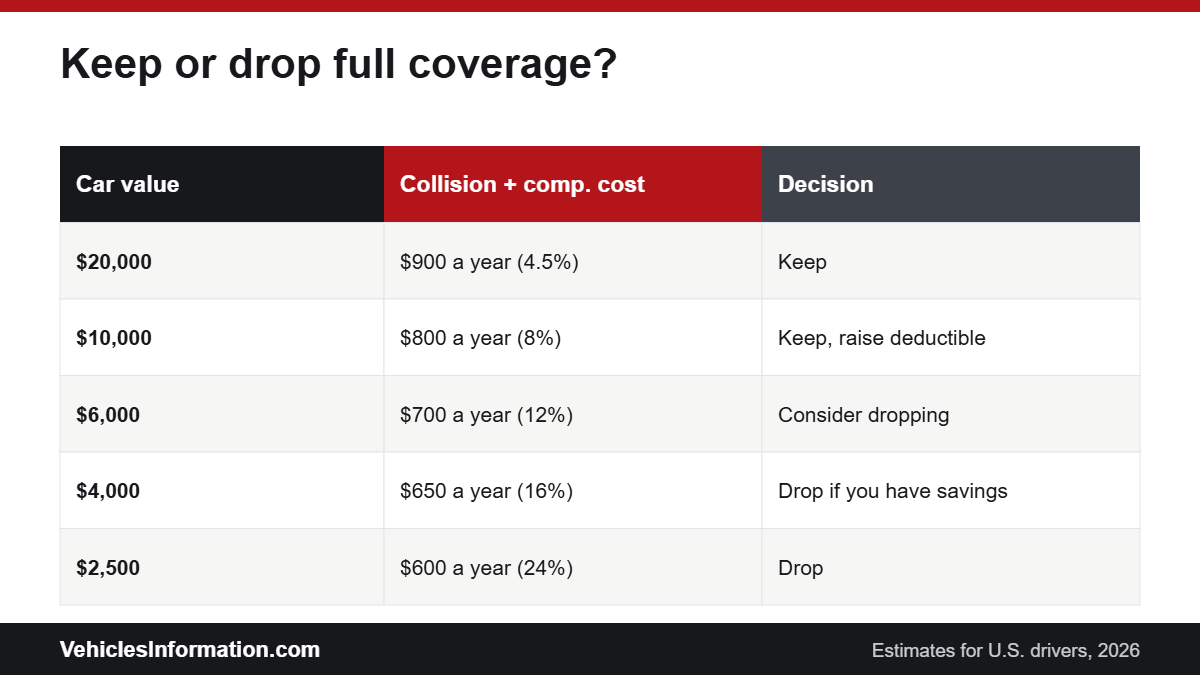
Drop full coverage when your car is paid off and the yearly cost of collision and comprehensive is more than about 10% of the car’s value, or the car is worth less than about $4,000 and you could replace it from savings. Until then, full coverage usually pays for itself.
Compare liability and full coverage prices side by side in our car insurance calculator. For the basics, read full coverage vs. liability.
How to check in 3 steps
- Find your car’s value. Use a pricing guide’s private-party value for your exact trim and miles.
- Find the cost of collision and comprehensive. It is listed separately on your policy declarations page.
- Divide cost by value. Over 10% means the cover is expensive for what it can pay.
Remember the most you can ever get is the car’s value minus your deductible. A $3,000 car with a $1,000 deductible can pay out only $2,000.
When you should keep full coverage
- You still have a loan or lease.
- You could not afford another car if this one were totaled.
- You live where hail, flooding or theft are common. Consider keeping comprehensive only.
- The car is worth more than about $4,000 and the cost is under 10% of its value.
A middle option: keep comprehensive, drop collision
Comprehensive is much cheaper than collision and covers theft, hail, fire, flood and animal strikes. On an older car, keeping comprehensive and dropping collision can save most of the cost while still protecting against storms and theft.
What you save by dropping it
For an average U.S. driver, moving from full coverage ($175 a month) to liability with good limits ($123 a month) saves about $52 a month, or about $620 a year. Put that saving into an emergency fund for your next car.
Do not cut liability at the same time
When you drop collision, keep strong liability limits and uninsured motorist cover. Those protect your savings and health, which matter more than an old car.
Car value vs. yearly cost table
| Car value | Collision + comprehensive per year | Most you can get back ($500 deductible) | Keep or drop? |
|---|---|---|---|
| $15,000 | $900 | $14,500 | Keep |
| $8,000 | $780 | $7,500 | Keep, raise deductible |
| $5,000 | $700 | $4,500 | Borderline |
| $3,000 | $650 | $2,500 | Drop if you have savings |
| $1,500 | $600 | $1,000 | Drop |
How to drop full coverage (step by step)
- Make sure the loan or lease is paid off and you have the lien release.
- Log in or call your insurer and remove collision (and comprehensive, if you choose).
- Raise liability limits to 100/300/100 if you can, using part of the savings.
- Keep uninsured motorist cover.
- Put the monthly saving into a car replacement fund.
Factors that can change the answer
- Your state: in hail, flood or high-theft states, keep comprehensive longer.
- Your driving: new or young drivers crash more often, so collision pays out more often.
- Rental needs: without collision, you get no rental car after a crash you cause.
- Your savings: if losing the car would stop you getting to work, keep collision a little longer.
Frequently asked questions
Should I drop full coverage on a 10-year-old car?
Only if it is paid off and collision and comprehensive cost more than about 10% of its value each year.
Can I drop full coverage after my loan is paid?
Yes. Ask your lender for the lien release and then call your insurer.
Is it worth keeping comprehensive only?
Often yes, because it is cheap and covers theft and weather damage.
About our numbers
Prices on this page are estimates for U.S. drivers, built from 2025–2026 published rate studies (including Insurify, CarInsurance.com, The Zebra and state insurance department rules) and our own pricing model. Percentages for age, tickets, accidents, DUI, credit and vehicle type are our model estimates, not quotes. Your insurer, ZIP code and history will change your price. Read how we estimate car insurance costs.
This is general information, not insurance or legal advice.

VehiclesInformation Editorial Team
The VehiclesInformation Editorial Team researches and writes our car and car insurance guides for U.S. drivers. Insurance figures are checked against state insurance department rules and published 2026 rate studies, and pages are updated when laws or rates change. Read how we estimate car insurance costs.