Written by: VehiclesInformation Editorial Team · Fact-checked against: state insurance department rules and 2026 rate data (our methodology) · Last reviewed: October 2026
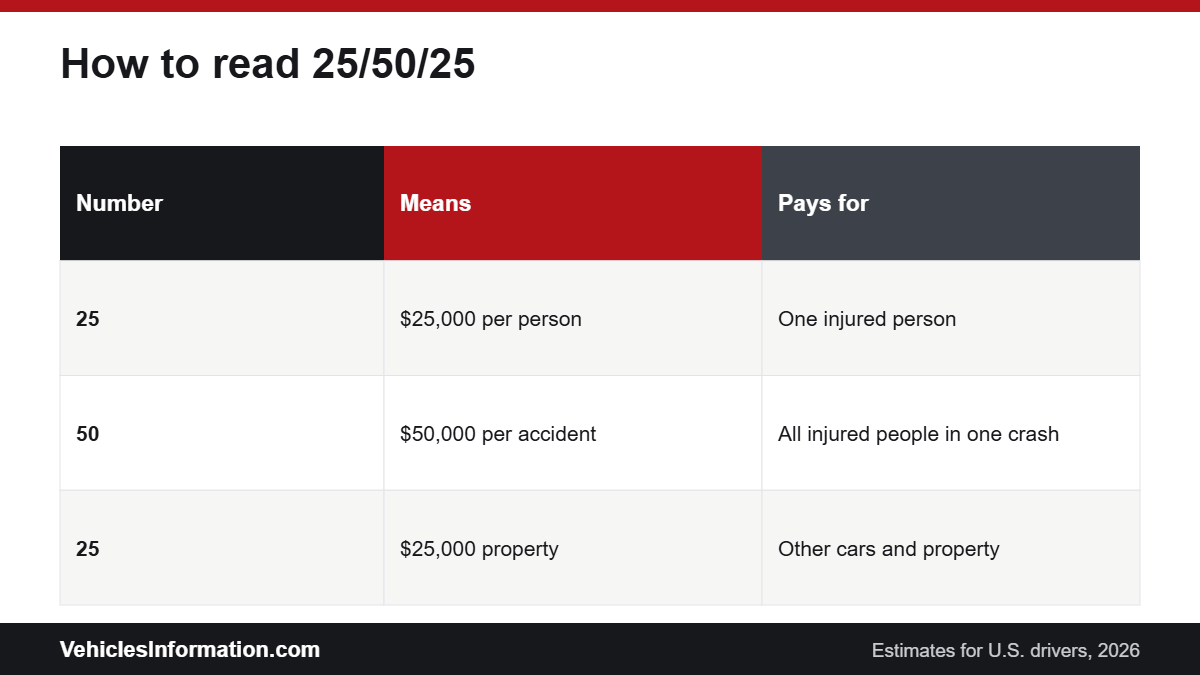
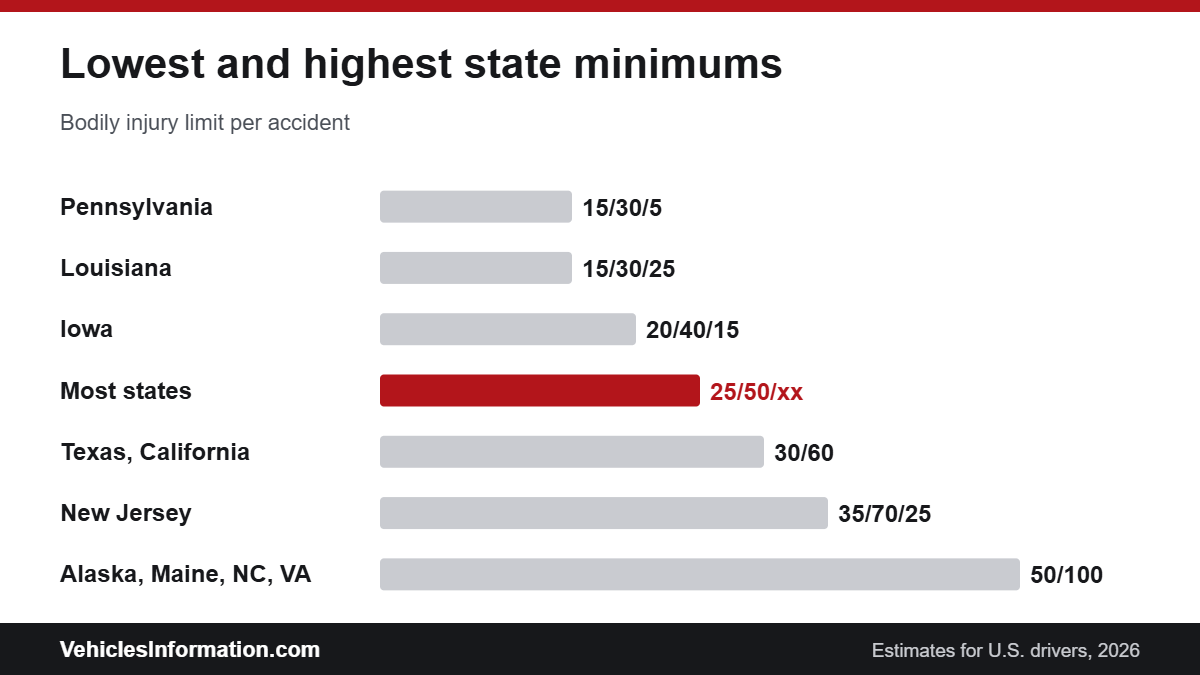
Every U.S. state except New Hampshire requires car insurance. Most states require at least 25/50/25 liability, meaning $25,000 per injured person, $50,000 per accident for injuries and $25,000 for property damage. About half the states also require personal injury protection (PIP) or uninsured motorist (UM) cover. The full 2026 list is below.
See what minimum and full coverage cost in your state with our car insurance calculator by state.
Minimum car insurance requirements by state (2026)
| State | Liability minimum | Also required |
|---|---|---|
| Alabama | 25/50/25 | — |
| Alaska | 50/100/25 | — |
| Arizona | 25/50/15 | — |
| Arkansas | 25/50/25 | — |
| California | 30/60/15 | — |
| Colorado | 25/50/15 | — |
| Connecticut | 25/50/25 | UM/UIM |
| Delaware | 25/50/10 | PIP |
| District of Columbia | 25/50/10 | UM, UMPD |
| Florida | No BI / $10k PD | PIP $10k |
| Georgia | 25/50/25 | — |
| Hawaii | 40/80/20 | PIP |
| Idaho | 25/50/15 | — |
| Illinois | 25/50/20 | UM |
| Indiana | 25/50/25 | UM/UIM unless rejected |
| Iowa | 20/40/15 | — |
| Kansas | 25/50/25 | UM/UIM, PIP |
| Kentucky | 25/50/25 | PIP $10k |
| Louisiana | 15/30/25 | — |
| Maine | 50/100/25 | UM/UIM, MedPay |
| Maryland | 30/60/15 | UM/UIM, PIP |
| Massachusetts | 25/50/30 | UM, PIP |
| Michigan | 50/100/10 | PIP, PPI $1M |
| Minnesota | 30/60/10 | UM/UIM, PIP |
| Mississippi | 25/50/25 | — |
| Missouri | 25/50/25 | UM |
| Montana | 25/50/20 | — |
| Nebraska | 25/50/25 | UM/UIM |
| Nevada | 25/50/20 | — |
| New Hampshire | 25/50/25 if insured | Insurance not required |
| New Jersey | 35/70/25 | UM/UIM, PIP |
| New Mexico | 25/50/10 | — |
| New York | 25/50/10 | UM, PIP $50k |
| North Carolina | 50/100/50 | UM/UIM |
| North Dakota | 25/50/25 | UM/UIM, PIP |
| Ohio | 25/50/25 | — |
| Oklahoma | 25/50/25 | — |
| Oregon | 25/50/20 | UM, PIP |
| Pennsylvania | 15/30/5 | First-party medical |
| Rhode Island | 25/50/25 | UM unless rejected |
| South Carolina | 25/50/25 | UM, UMPD |
| South Dakota | 25/50/25 | UM/UIM |
| Tennessee | 25/50/25 | — |
| Texas | 30/60/25 | PIP/UM unless rejected |
| Utah | 30/65/25 | UM, PIP |
| Vermont | 25/50/10 | UM/UIM, UMPD |
| Virginia | 50/100/25 | UM/UIM, UMPD |
| Washington | 25/50/10 | — |
| West Virginia | 25/50/25 | UM, UMPD |
| Wisconsin | 25/50/10 | UM, MedPay |
| Wyoming | 25/50/20 | — |
UM = uninsured motorist, UIM = underinsured motorist, UMPD = uninsured motorist property damage, PIP = personal injury protection, MedPay = medical payments. Rules change, so check your state’s motor vehicle or insurance department before you buy.
Lowest and highest minimums
Is the state minimum enough?
Rarely. A single hospital stay can cost more than $25,000, and a newer car can cost more than $25,000 to replace. If a crash you cause costs more than your limits, you can be sued for the difference. Most experts suggest:
- At least 100/300/100 if you own a home or have savings.
- Uninsured motorist cover matching your liability limits, even where it is optional.
- An umbrella policy if your net worth is high.
Moving from state minimum to 100/300/100 often costs only $15 to $40 more a month.
What happens if you drive without insurance?
- Fines, usually a few hundred to a few thousand dollars.
- License or registration suspension.
- Your car may be impounded in some states.
- You may need an SR-22 filing and pay much higher rates afterward.
- You are personally responsible for all damage you cause.
Coverage types in the table, explained
- Bodily injury liability: injuries you cause to others.
- Property damage liability: other people’s cars and property.
- Personal injury protection (PIP): your own medical bills and lost wages, any fault. Required in most no-fault states.
- Uninsured / underinsured motorist (UM/UIM): pays you when the at-fault driver has no or too little insurance.
- Medical payments (MedPay): medical bills for you and passengers.
States with the highest required minimums
| State | Minimum |
|---|---|
| North Carolina | 50/100/50 + UM/UIM |
| Alaska | 50/100/25 |
| Maine | 50/100/25 + UM/UIM + MedPay |
| Virginia | 50/100/25 + UM/UIM |
| Michigan | 50/100/10 + PIP (default 250/500) |
| New Jersey | 35/70/25 + PIP + UM/UIM |
How much more does better coverage cost?
| Liability limits | Est. extra per month vs. 25/50/25 |
|---|---|
| 50/100/50 | about $8–$15 |
| 100/300/100 | about $15–$40 |
| 250/500/100 | about $30–$60 |
Estimates; the exact difference depends on your state and insurer. See prices for your state on our state calculator.
Proof of insurance rules
All states that require insurance expect you to carry proof in the car. Most accept a digital ID card on your phone. Many states also check insurance electronically when you register a car, and your insurer reports cancellations to the state. If your policy lapses, you can face fines, a suspended registration or license, and an SR-22 requirement. See our SR-22 cost calculator.
Frequently asked questions
Which state does not require car insurance?
New Hampshire, though drivers must prove they can pay for damage they cause, and buyers who do buy insurance must meet minimum limits.
Which states are no-fault?
Florida, Hawaii, Kansas, Kentucky, Massachusetts, Michigan, Minnesota, New Jersey, New York, North Dakota, Pennsylvania and Utah use no-fault systems, mostly requiring PIP.
What does 30/60/25 mean?
$30,000 per injured person, $60,000 per accident for injuries and $25,000 for property damage.
Is full coverage required by law?
No. It is only required by lenders and leasing companies.
About our numbers
Prices on this page are estimates for U.S. drivers, built from 2025–2026 published rate studies (including Insurify, CarInsurance.com, The Zebra and state insurance department rules) and our own pricing model. Percentages for age, tickets, accidents, DUI, credit and vehicle type are our model estimates, not quotes. Your insurer, ZIP code and history will change your price. Read how we estimate car insurance costs.
This is general information, not insurance or legal advice.

VehiclesInformation Editorial Team
The VehiclesInformation Editorial Team researches and writes our car and car insurance guides for U.S. drivers. Insurance figures are checked against state insurance department rules and published 2026 rate studies, and pages are updated when laws or rates change. Read how we estimate car insurance costs.