Written by: VehiclesInformation Editorial Team · Fact-checked against: state insurance department rules and 2026 rate data (our methodology) · Last reviewed: October 2026
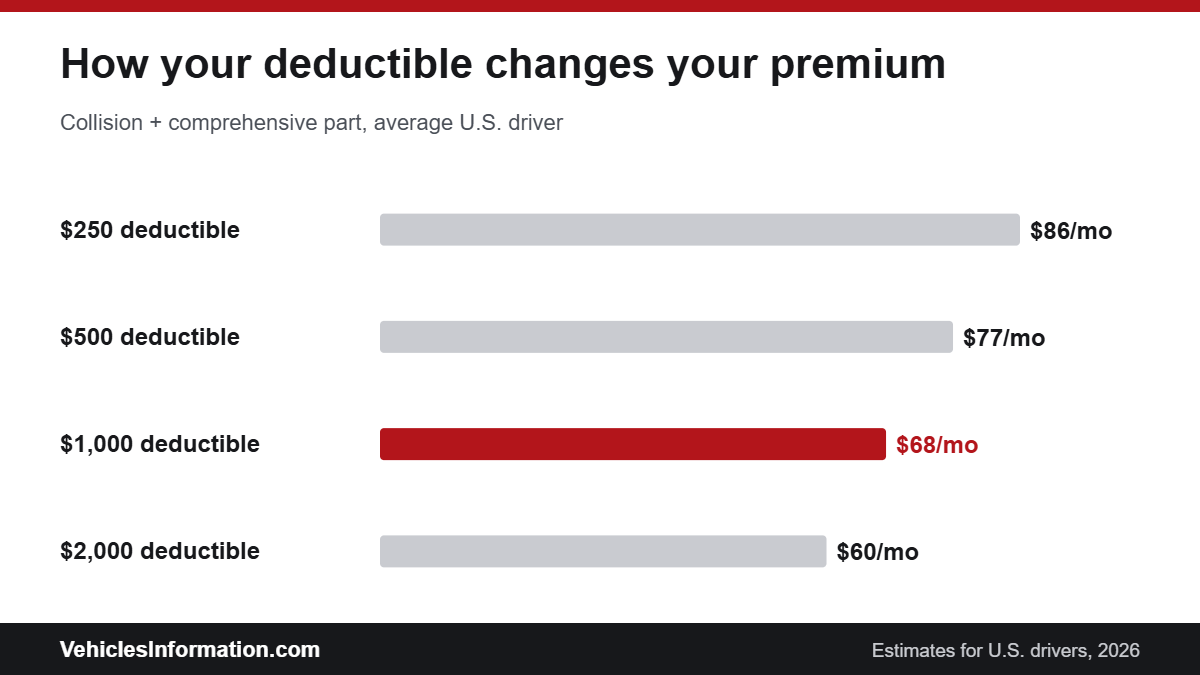
A deductible is the amount you pay out of pocket on a collision or comprehensive claim before your insurer pays the rest. Most drivers choose $500 or $1,000. Raising your deductible from $500 to $1,000 cuts the collision and comprehensive part of your premium by about 12%, roughly $9 a month or $110 a year for an average driver. Pick the highest deductible you could pay tomorrow without borrowing.
Compare deductibles for your own car in our car insurance calculator.
How a deductible works
Say you have a $1,000 deductible and a crash causes $4,000 of damage to your car. You pay $1,000 and your insurer pays $3,000. If the damage is $800, you pay all of it and your insurer pays nothing. Deductibles apply to collision and comprehensive. Liability claims, where you damage someone else’s property, have no deductible for you.
Savings by deductible
| Deductible | Collision + comprehensive (monthly) | Yearly | Saving vs. $500 |
|---|---|---|---|
| $250 | $86 | $1,032 | Costs $108 more |
| $500 | $77 | $924 | — |
| $1,000 | $68 | $816 | Saves about $110 |
| $2,000 | $60 | $720 | Saves about $205 |
The break-even rule
Divide the extra amount you would pay on a claim by the yearly saving. Moving from $500 to $1,000 adds $500 of risk and saves about $110 a year, so you break even in about 4.5 years without a claim. If you file a claim less often than that, the higher deductible usually wins.
Which deductible should you choose?
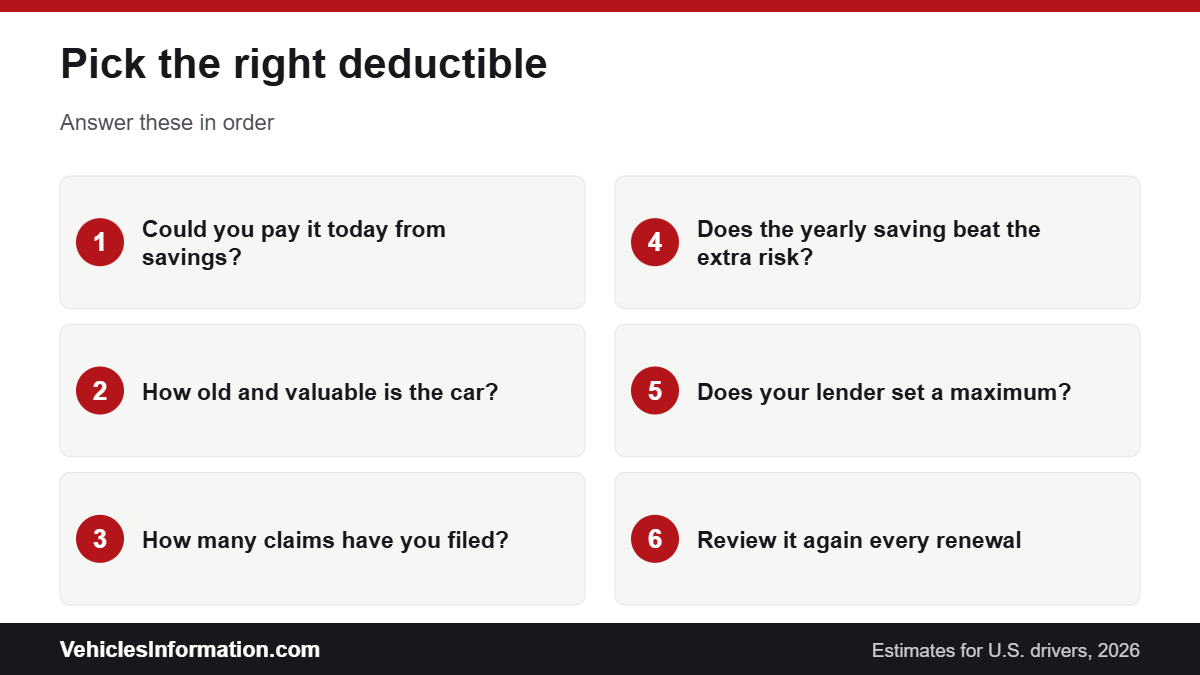
- $250–$500: little savings, a newer car, or a car you rely on every day.
- $1,000: the best fit for most drivers with an emergency fund.
- $2,000+: strong savings and a careful record; also good on an older car before you drop collision completely.
Many lenders cap the deductible at $500 or $1,000 on financed cars, so check your loan terms.
Separate deductibles for collision and comprehensive
You can often set them differently. A common choice is $1,000 on collision and $250 or $500 on comprehensive, because hail, glass and animal claims are frequent and comprehensive is cheaper. Some insurers offer $0 glass deductibles, and some states require them.
Deductible vs. premium: the full picture
| Deductible | Yearly premium (collision + comp.) | Cost if you have one claim a year | Cost with no claims |
|---|---|---|---|
| $250 | $1,032 | $1,282 | $1,032 |
| $500 | $924 | $1,424 | $924 |
| $1,000 | $816 | $1,816 | $816 |
| $2,000 | $720 | $2,720 | $720 |
Most drivers file a collision claim only once every several years, which is why a higher deductible usually wins over time.
Deductibles for different drivers
- New drivers and teens: often $500, because crashes are more likely in the first years.
- Drivers with an emergency fund: $1,000 is usually best.
- Older, paid-off cars: $1,000–$2,000, or drop collision altogether. See when to drop full coverage.
- Hail or theft-prone areas: keep a lower comprehensive deductible.
Other deductibles to know
- PIP deductible: in no-fault states such as Florida, a PIP deductible lowers that part of your premium.
- Uninsured motorist property damage: often has a small deductible, such as $250.
- Glass: some insurers and some states offer a $0 glass deductible.
- Disappearing deductible: some insurers lower your deductible for each claim-free year.
Frequently asked questions
Is a $1,000 deductible better than $500?
For most people with savings, yes. It saves about $110 a year on average.
Do I pay a deductible if I am not at fault?
Not when the other driver’s insurer pays. If you use your own collision cover first, your insurer may recover your deductible from the other insurer.
Does liability insurance have a deductible?
No. Deductibles apply to cover for your own car.
Can I change my deductible anytime?
Yes, usually at any time, effective for future claims.
About our numbers
Prices on this page are estimates for U.S. drivers, built from 2025–2026 published rate studies (including Insurify, CarInsurance.com, The Zebra and state insurance department rules) and our own pricing model. Percentages for age, tickets, accidents, DUI, credit and vehicle type are our model estimates, not quotes. Your insurer, ZIP code and history will change your price. Read how we estimate car insurance costs.
This is general information, not insurance or legal advice.

VehiclesInformation Editorial Team
The VehiclesInformation Editorial Team researches and writes our car and car insurance guides for U.S. drivers. Insurance figures are checked against state insurance department rules and published 2026 rate studies, and pages are updated when laws or rates change. Read how we estimate car insurance costs.