
A car that smells like gas is telling you that liquid fuel or fuel vapor is escaping somewhere it shouldn’t. Sometimes the cause is harmless, like a few drops on your shoe after filling up or a gas cap that didn’t click. Other times it’s a cracked fuel line dripping near a hot exhaust, and that can start a fire. The good news is that when and where you notice the smell narrows the cause down fast. This guide walks you through every common reason, how to tell them apart in a few minutes, what’s safe to drive and what isn’t, and what each repair usually costs in the U.S. in 2026.
Is it safe to drive if your car smells like gas?
Short answer: not until you know why. A faint smell that fades within a few minutes of leaving the pump is usually spilled fuel. A strong, steady smell, or any smell together with dripping fluid, is a reason to stop driving.
Stop, turn the engine off and do not restart it if you notice any of these:
- Fluid dripping or a wet spot under the car that smells like gasoline
- A strong smell from under the hood, especially right after you park
- The smell keeps getting stronger while you drive
- Smoke, or a “hot” fuel smell mixed with burning odors
- Headache, dizziness or nausea while you’re inside the car
In any of those cases, get everyone out, keep anything that sparks or burns away from the car (no smoking, no lighters), let the engine cool, and have the car towed to a shop. A tow costs far less than a vehicle fire. If you smell gas but see no drips and the smell is faint, open the windows, drive gently to a safe place and do the quick checks further down this page.
Find the cause by when you smell it
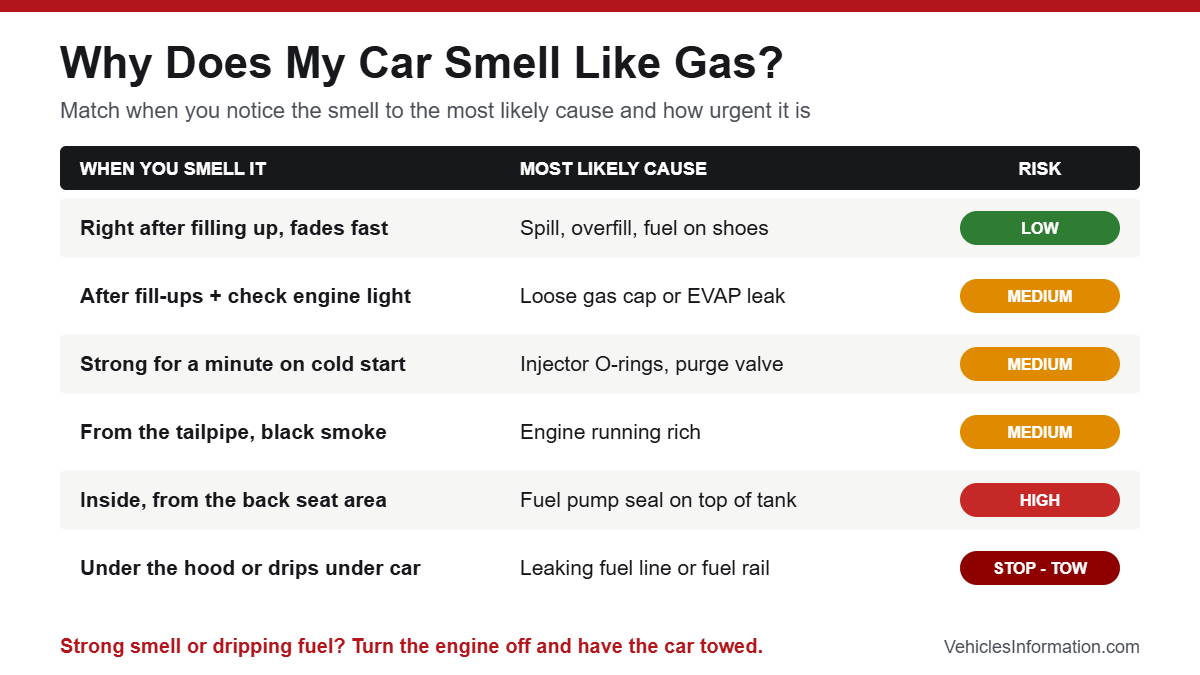
Mechanics start with one question: when does it smell? Use this table to match your situation to the most likely cause before you read the details.
| When you notice the smell | Most likely cause | How serious |
|---|---|---|
| Right after filling up, fades in a few minutes | Spilled fuel, overfilling, gas on shoes or hands | Low |
| After filling up, lasts for days, check engine light | Loose or worn gas cap, EVAP leak | Low to medium |
| Strong for a minute or two after a cold start | Leaking injector O-ring, rich cold start, EVAP purge valve | Medium |
| Under the hood after you park | Leaking fuel line, fuel rail or injector seal | High |
| Inside the cabin, from the back seat area | Fuel pump/sending unit seal on top of the tank | Medium to high |
| Through the AC or heater vents | Leak near the cowl air intake, or exhaust fumes being pulled in | Medium to high |
| From the tailpipe, with black smoke or poor mileage | Engine running rich (sensor, regulator or injector fault) | Medium |
| In the garage overnight with the engine off | EVAP vent leak, tank or filler neck leak | Medium to high |
| When you check the oil, the oil smells like fuel | Fuel diluting the engine oil | Medium |
| Only in heavy traffic or near other cars | Fumes from vehicles around you | Low |
12 reasons your car smells like gas
1. You just filled up (spill, overfill or vapor on you)
This is the most common reason and the least worrying. A few drops on the side of the car, on your shoes or on your hands are enough to fill the cabin with that smell for ten minutes or so. Topping off the tank after the nozzle clicks makes it more likely, because the extra fuel can spill out of the filler neck or get pushed into the vapor system.
How to tell: the smell starts at the pump and fades as you drive. Wash your hands, wipe your shoe soles and wipe any spill near the filler door with a damp cloth.
Fix: stop pumping at the first automatic click. If the smell still hangs around a day later, it isn’t a spill. Keep reading.
2. A loose, damaged or missing gas cap
Your fuel system is sealed. The gas cap (or the spring-loaded flap on capless fillers) keeps vapor inside the tank. If the cap isn’t tightened until it clicks, the rubber seal is cracked, or the cap was left on the pump, fuel vapor escapes near the filler door and often finds its way into the cabin.
How to tell: the smell is strongest at the rear quarter of the car on the fuel-door side. Many cars also turn on the check engine light within a day or two and store codes such as P0457 (leak detected, fuel cap loose or off) or P0455 (large EVAP leak). Some models show a “Check fuel cap” message on the dash.
Fix: tighten the cap until it clicks at least once. Look at the rubber O-ring for cracks or flat spots. A new cap costs about $15 to $40. On a capless filler, check that the flap closes fully and isn’t held open by dirt. The check engine light may take several drive cycles to go off after you fix it.
3. An EVAP system leak (purge valve, vent valve or charcoal canister)
The evaporative emission (EVAP) system catches gasoline vapor from the tank, stores it in a charcoal canister, and later lets the engine burn it. It uses a purge valve near the engine, a vent valve near the tank, a canister and a lot of hoses. When one of these parts cracks or sticks, raw fuel vapor leaks out instead of being burned.
How to tell: a light, steady fuel smell around the car, often worse on hot days or after refueling, plus a check engine light. Common codes are P0440, P0441, P0442 (small leak), P0446 (vent control), P0455 (large leak) and P0456 (very small leak). A purge valve that sticks open can also cause a rough idle right after filling up or a hard start after a fill-up.
Fix: a shop finds EVAP leaks with a smoke test, which pumps harmless visible smoke into the system so the leak shows itself. Diagnosis usually costs $75 to $150. A purge valve replacement typically runs about $150 to $450, and larger EVAP repairs involving the canister and hoses can climb to $400 to $1,500 on some vehicles.
One habit wrecks charcoal canisters: topping off the tank. Liquid fuel soaks the charcoal, and from then on the canister can’t hold vapor properly. If your car smells like gas mostly after fill-ups and you routinely top off, that’s a strong clue.
4. Leaking fuel lines or hoses
Fuel lines carry gasoline from the tank at the back of the car to the engine at the front. Modern fuel-injected engines run these lines under pressure, so even a pinhole leak can spray or drip steadily. Rubber sections dry out and crack with age and heat. Metal lines rust, especially in states that salt their roads in winter.
How to tell: a strong, raw gasoline smell, often under the car or under the hood, and wet spots or drips that evaporate fast and leave a faint rainbow sheen. Look along the frame rail from the tank to the engine with a flashlight.
Fix: do not keep driving. A leaking fuel line is one of the main causes of vehicle fires because gasoline can drip onto the hot exhaust. Replacing a section of line or a hose usually costs a few hundred dollars depending on how much line is damaged and how hard it is to reach.
5. Fuel injector O-rings or a leaking fuel rail
Each fuel injector seals into the engine and the fuel rail with small rubber O-rings. Years of heat make those O-rings hard, and they start to seep, especially when the engine is cold and the rubber has shrunk. On direct-injection engines the fuel pressure is extremely high, so a weak seal leaks quickly.
How to tell: the smell is strongest under the hood and right after a cold start, then may fade as the engine warms. You might see dampness or a crusty residue around the injectors on top of the engine.
Fix: replacing injector O-rings and seals usually costs about $150 to $450. If an injector itself is leaking, replacing it costs more, depending on the engine and how many injectors are affected.
6. A faulty fuel pressure regulator
The fuel pressure regulator keeps fuel pressure steady. When its internal diaphragm tears, gasoline can leak out, or get sucked into the engine through a vacuum hose and make the engine run rich.
How to tell: gas smell under the hood, black smoke from the tailpipe, poor fuel economy, and on some cars a wet vacuum hose at the regulator. Codes like P0172 (system too rich) are common.
Fix: a regulator replacement typically costs about $225 to $450 at a shop. Many newer cars have the regulator inside the fuel pump module in the tank, which adds labor.
7. The engine is running rich
“Running rich” means the engine is getting more fuel than it can burn. Unburned gasoline leaves through the exhaust, so you smell fuel at the tailpipe and sometimes inside the car. Common triggers are a bad oxygen sensor, a faulty coolant temperature sensor that tells the computer the engine is always cold, a leaking injector, a misfire from a worn spark plug or coil, or a badly clogged air filter on older engines.
How to tell: fuel smell from the exhaust, black soot on the tailpipe tip, rough idle, and noticeably worse gas mileage. Codes P0172, P0175 or misfire codes (P0300 to P0308) are typical.
Fix: repair the root cause quickly. Raw fuel overheats and damages the catalytic converter, which is far more expensive to replace than a sensor or spark plug.
8. A leaking fuel tank, filler neck or fuel pump seal
Fuel tanks rust along their seams (older steel tanks) or get punctured by road debris. The filler neck, the pipe between the fuel door and the tank, rusts from the inside on older cars. On many sedans and SUVs the fuel pump sits on top of the tank under the rear seat, held in by a large rubber seal. When that seal shrinks or wasn’t seated right after a pump replacement, vapor leaks straight into the cabin.
How to tell: a wet stain or drips under the rear of the car, a smell that’s worse right after a fill-up when the tank is full, or a smell inside that seems to come from the back seat area.
Fix: a new pump seal is cheap, but labor depends on access. A full tank replacement is one of the bigger bills on this list. RepairPal puts the national average at roughly $1,686 to $1,892 including parts and labor. A filler neck usually costs much less than a tank.
9. A leaking fuel filter
Older and some heavy-duty vehicles use an inline fuel filter under the car. Rust on the housing, loose fittings or a filter installed without the right clips can drip fuel.
How to tell: wetness right at the filter, usually along the frame rail. Fix: filters are cheap parts, typically $10 to $45, plus labor. Many newer cars have the filter inside the tank and it isn’t a common leak point.
10. A loose or cracked spark plug
If a spark plug isn’t tightened correctly or its porcelain is cracked, unburned fuel and combustion gases can escape from the cylinder. You get a fuel and exhaust smell under the hood, often with a ticking sound and a misfire. A shop can reseat or replace the plug, usually for well under $200 unless the threads are damaged.
11. Gasoline in the engine oil
Pull the dipstick and smell it. If the oil smells like gasoline, fuel is getting past the piston rings and mixing with the oil. This is called fuel dilution. It’s more common on direct-injection and turbocharged engines, cars driven mostly on short trips in cold weather, and engines with a leaking injector.
How to tell: oil smells of fuel, the oil level seems to rise between changes, and you may smell fuel near the oil filler cap. A missing or loose oil cap makes the smell worse. Fix: change the oil, drive the car long enough to fully warm up regularly, and have injectors and engine software checked. Some models have had software updates for this exact problem, so ask the dealer.
12. A gas can, lawn mower or fuel-soaked item in the car
Sometimes the car isn’t the problem at all. A gas can in the trunk, a leaf blower, a lawn mower in the bed of a truck, or a jacket that brushed against a fuel nozzle can all fill the car with fumes. Gas cans also “breathe” in hot weather and push vapor out.
Fix: carry fuel only in an approved, sealed container, keep it upright and secured, and move it to an open truck bed or outside the cabin when you can. Never keep a gas can in a closed car on a hot day.
Car smells like gas through the AC or heater vents
Your heating and AC system pulls outside air in through a grille at the base of the windshield, called the cowl. Anything that leaks near that intake gets pulled straight into the cabin. On many cars the fuel injectors and fuel rail sit just below the cowl, so a small injector leak can smell much stronger inside than outside.
Two other common reasons: you were following a car with a bad exhaust and the system pulled in its fumes, or your own car has an exhaust leak. Exhaust smells different from raw gas, it’s sharper and more “burnt”, and it can carry carbon monoxide, which you can’t smell. If the smell only appears in traffic, switch the system to recirculate and see if it clears. If it shows up with the windows closed on an open road, have the car inspected.
Car smells like gas when parked or in the garage
A smell in the garage overnight, with the engine off, points to the tank, filler neck, EVAP vent valve or a slow drip from a fuel line. Heat makes it worse because gasoline evaporates faster.
- Open the garage door and air it out before you do anything else.
- Don’t flip light switches or use power tools near a strong smell.
- Put a piece of cardboard under the car overnight. In the morning, a wet spot tells you exactly where the leak is.
- Never warm up the car with the garage door closed.
Car smells like gas when you start it
A short burst of fuel smell for the first minute after a cold start is fairly common on older cars, because the engine runs rich until it warms up. If the smell is strong, lasts more than a couple of minutes, or comes with a rough idle, suspect leaking injector O-rings, a stuck-open purge valve, or a coolant temperature sensor that keeps the engine running rich. Check under the hood right after a cold start, when cold rubber seals leak the most.
Gas smell or something else? Compare the smells
| What it smells like | What it usually means |
|---|---|
| Raw gasoline, like at the pump | Fuel or fuel vapor leak (this guide) |
| Rotten eggs or sulfur | Catalytic converter problem or engine running rich |
| Sweet, like syrup | Coolant (antifreeze) leak from the radiator, hoses or heater core |
| Burning oil | Oil leaking onto the exhaust manifold |
| Burnt, sharp exhaust fumes inside | Exhaust leak. Carbon monoxide risk, get it checked right away |
| Burning rubber or plastic | Slipping belt, rubbing hose or electrical problem |
| Musty, like old socks | Mold in the AC evaporator or a clogged cabin air filter |
Check engine codes linked to a gas smell
| Code | Meaning | Common cause |
|---|---|---|
| P0440 | EVAP system malfunction | General EVAP fault |
| P0441 | Incorrect purge flow | Purge valve stuck or hose problem |
| P0442 | Small EVAP leak | Cracked hose, worn cap seal |
| P0446 | EVAP vent control circuit | Vent valve fault |
| P0455 | Large EVAP leak | Gas cap off, disconnected hose |
| P0456 | Very small EVAP leak | Tiny crack, cap seal |
| P0457 | Leak detected, fuel cap loose or off | Gas cap |
| P0172 / P0175 | System too rich | Leaking injector, bad sensor, regulator |
| P0300–P0308 | Misfire | Spark plug, coil, injector |
Most auto parts stores in the U.S. will read your codes for free, or you can buy a basic OBD2 scanner for about $20 to $40.
How to find the source in 5 minutes
- Park safely and switch the engine off. Let the engine cool before you touch anything under the hood.
- Look under the car. Use a flashlight from the tank at the back to the engine at the front. Gas evaporates fast, so look for wet spots and rainbow-colored stains, not puddles.
- Check the gas cap. Remove it, inspect the seal, and tighten it until it clicks.
- Sniff by zone. Rear of the car near the tank, the fuel door, the engine bay, the tailpipe, and the back seat. The strongest spot is usually closest to the leak.
- Check the oil. If the dipstick smells like gasoline, it’s fuel dilution, not an external leak.
- Read the codes. An EVAP code points to the vapor system. A rich or misfire code points to the engine.
- Check for recalls. Enter your VIN on the NHTSA recall lookup or your automaker’s owner site. Fuel leak recalls are fixed free at the dealer.
If you find fuel dripping anywhere, stop there and arrange a tow.
How much does it cost to fix a gas smell?
Here are typical U.S. shop prices in 2026, including parts and labor. Prices vary by vehicle, region and shop, and dealers usually charge more than independent shops.
| Repair | Typical cost |
|---|---|
| New gas cap | $15–$40 |
| EVAP smoke test (diagnosis) | $75–$150 |
| Purge valve replacement | $150–$450 |
| Larger EVAP repair (canister, vent valve, hoses) | $400–$1,500 |
| Fuel injector O-rings and seals | $150–$450 |
| Fuel pressure regulator | $225–$450 |
| Fuel line or hose repair | $150–$600 |
| Inline fuel filter (part) | $10–$45 plus labor |
| Fuel tank replacement | About $1,686–$1,892 (national average) |
If a recall covers your car, the repair is free. Ask for a written estimate before any work, and ask the shop to show you the leak.
Fuel leak recalls to know about in 2026
Automakers recall cars for fuel leaks every year, so a gas smell on a newer car is worth a VIN check. One example: in April 2026, Kia and Genesis filed recalls for about 245,000 vehicles with the 3.5-liter V6, including the 2021–2025 Kia Carnival and several Genesis G80, G90, GV70 and GV80 model years. Nuts on a high-pressure fuel pipe may not have been tightened to specification, which can let fuel leak and raise the risk of fire. Dealers inspect the pipe, tighten the fittings or replace the pipe for free. If you own one of these models and smell fuel, contact a dealer instead of waiting for the letter.
Can a gas smell in your car make you sick?
Breathing gasoline vapor for a short time usually causes headaches, dizziness, nausea or a burning feeling in the eyes and throat. Longer or heavier exposure is more harmful, and gasoline contains benzene, which you don’t want to breathe regularly. If you feel unwell, get out of the car and into fresh air. If symptoms are severe, or you suspect exhaust fumes instead of raw gas, seek medical help, because carbon monoxide has no smell. Children and pets should not ride in a car that smells of fuel.
How to get rid of gas smell inside your car
If fuel spilled inside the car, for example from a gas can, clean it quickly:
- Open all doors and windows and park outside, away from any flame or spark.
- Blot, don’t rub, the spill with paper towels or old rags.
- Sprinkle baking soda over the area, leave it for several hours or overnight, then remove it with a hand brush. Avoid a regular household vacuum on fresh fuel.
- Wash the area with warm water and a little dish soap, then blot dry.
- Repeat if needed, and leave the windows down in a safe, dry place to air out.
- Let fuel-soaked rags dry outdoors, spread out, before throwing them away. Never pile them up in a closed bin.
If the smell comes back after cleaning, the source isn’t the spill. Have the fuel system checked.
Does car insurance cover a fuel leak?
Insurance usually does not pay to repair a fuel leak caused by age or wear, that’s normal maintenance. But if a leak leads to a fire, comprehensive coverage generally pays for the damage, subject to your deductible. Liability-only policies don’t cover fire damage to your own car. Our guide to full coverage vs liability explains the difference, and you can see what each level might cost you with our car insurance calculator, no personal details needed.
How to prevent gas smells
- Stop fueling at the first click. Don’t top off.
- Tighten the gas cap until it clicks, and replace it if the seal looks worn.
- Don’t ignore an EVAP check engine light, small leaks get bigger.
- Ask your mechanic to look over fuel lines and the tank during oil changes, especially on cars older than 10 years or in road-salt states.
- Drive long enough for the engine to fully warm up at least once a week if you mostly make short trips.
- Check for open recalls with your VIN a couple of times a year.
Frequently asked questions
Why does my car smell like gas but there’s no leak?
The most common reasons are a loose gas cap, an EVAP vapor leak, fuel on your shoes or hands after filling up, the engine running rich, or gasoline in the engine oil. These release vapor without any visible drips.
Why does my car smell like gas after filling up?
Usually because of a small spill, topping off, or a gas cap that wasn’t tightened. If the smell lasts more than a day, check the cap seal and have the EVAP system tested.
Is it dangerous to drive a car that smells like gas?
It can be. A faint smell that fades after refueling is low risk. A strong or growing smell, or any dripping fuel, is a fire risk. Stop driving and have the car towed.
Why does my car smell like gas when I start it?
A brief smell on a cold start can be normal on older cars. A strong or lasting smell often means leaking injector O-rings, a stuck purge valve or a sensor making the engine run rich.
Why does my car smell like gas through the vents?
The ventilation system pulls in air near the base of the windshield, close to the fuel injectors on many engines. A small injector leak, an exhaust leak or fumes from nearby traffic can enter the cabin this way.
Will a gas leak turn on the check engine light?
Vapor leaks in the EVAP system usually will, with codes like P0442, P0455 or P0456. A liquid leak from a fuel line may not trigger any light, so never wait for one.
How much does it cost to fix a gas smell?
Anywhere from $15 for a new gas cap to about $1,700 to $1,900 for a fuel tank replacement. Most EVAP, injector seal and regulator repairs fall between $150 and $450.
Can a gas smell in the car make you sick?
Yes. Short exposure can cause headaches, dizziness and nausea. Get fresh air, and seek medical help if symptoms are severe.