
Want a ballpark car insurance price without handing over your phone number, email or name? Use the calculator below. It gives you a monthly, six-month and yearly estimate in seconds, and it never asks who you are, where you live down to the street, or how to reach you. Nobody calls you afterward, because we don’t collect anything to call.
Car insurance cost calculator
No name, email, phone or ZIP code. Pick your options and get an estimate in one click.
Written by the VehiclesInformation Editorial Team · Checked against state insurance department rules and 2026 rate data · Last reviewed: November 2026
Can you get a car insurance quote without a phone number?
Yes, if what you need is an estimate. A calculator like ours, or a rate table built from published averages, can tell you roughly what a driver like you pays in your state without any contact details at all.
A real, bindable quote from an insurance company is different. To give you a price they will actually honor, insurers need to run your driving record and, in most states, a credit-based insurance score. That means they need your name, date of birth and address. A phone number is often marked as required on the form, but on many direct insurer websites it is only used for your account, not for sales calls. The flood of calls people complain about usually comes from comparison and “free quotes” sites, not from the insurer itself.
So the smart order is simple: get an anonymous estimate first, decide which coverage level you actually want, and only then share your details with two or three insurers you picked yourself.
Why one online quote can lead to 20 phone calls
If you have ever typed your info into a “compare 10 quotes” site and then watched your phone light up for a week, you are not imagining it. Many of those sites are lead generators. They don’t sell insurance. They sell your request, often to several agents and call centers at once, and the fine print near the Submit button usually gives all of them permission to call and text you, sometimes with autodialers.
It works the same way whether you are in a Phoenix apartment complex or a farmhouse outside Des Moines. A single form can reach agents across the country within minutes, and each one is racing to call you first. That is why people on Reddit’s personal finance boards keep asking the same thing: how do I get a price without the calls?
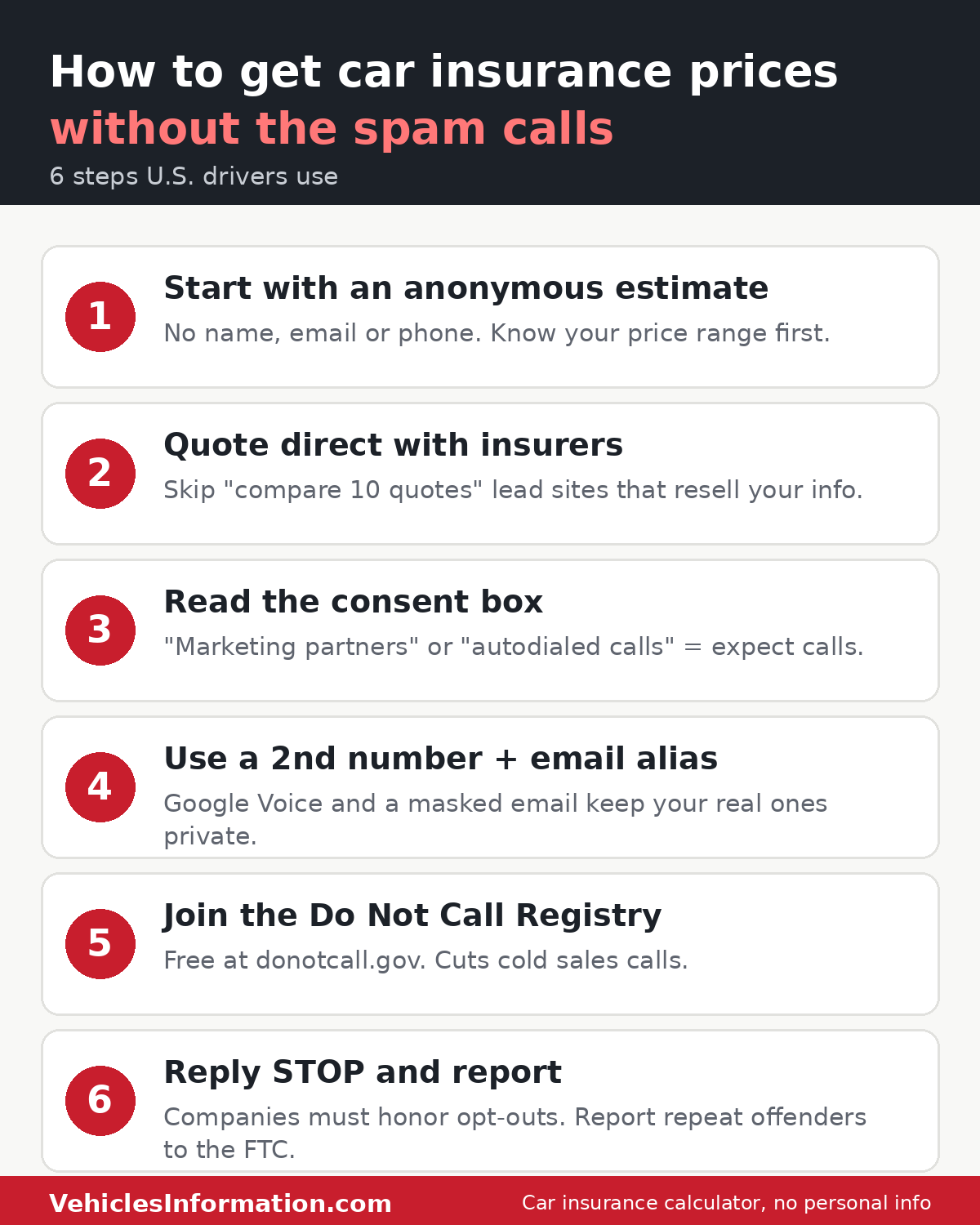
How to shop for car insurance without spam calls
These steps come straight from the tricks drivers swap online, plus what actually works with how quote forms are built.
- Start with an anonymous estimate. Use the calculator on this page to see your likely monthly price and which coverage level makes sense. You’ll know if a quote is high before anyone has your number.
- Go direct to insurers, not “compare” sites. Quote on the insurer’s own website. Your info stays with that one company instead of being passed around.
- Read the consent box before you hit Submit. If the text mentions “marketing partners,” “network of providers” or autodialed calls, that form is built to share your details. Close the tab.
- Use a second phone number and a masked email. A free Google Voice number and an email alias (like Apple’s Hide My Email or Firefox Relay) keep sales follow-ups away from your real inbox and cell. Never type in a random number that might belong to someone else.
- Put your number on the National Do Not Call Registry. Sign up free at donotcall.gov. It won’t stop a company you gave permission to, but it cuts down cold calls.
- Reply STOP and ask to be removed. Legitimate companies must honor an opt-out. If one keeps calling after you said stop, you can report it to the FTC.
How to use the car insurance calculator
- Pick your state. Location is the biggest single price factor. The same driver can pay about $85 a month for full coverage in New Hampshire and over $300 in Maryland.
- Choose your vehicle type and model year. A minivan or pickup usually costs less to insure than a sports car or a luxury EV, because repairs are cheaper.
- Add the driver’s age range, driving record and yearly miles. These are rating groups, not personal details. A 19-year-old in Atlanta and a 45-year-old in Boise sit in very different price bands.
- Set your deductible and credit tier. Both are optional. Leave credit on “Not sure” if you don’t know it.
- Choose a coverage level and press Calculate. You’ll see a monthly, six-month and yearly estimate, a likely price range, and all three coverage levels side by side.
How we work out your estimate
Every estimate starts from the average monthly price for full coverage and for liability-only coverage in your state, based on 2026 market rates for drivers aged 20 to 70 with a clean record. We then adjust that starting point for each answer you give:
- Driver age: teen drivers pay about 2.6 times what a 35 to 54-year-old pays. Prices drop fast after 25 and creep up a little after 65.
- Driving record: one speeding ticket adds about 22%, one at-fault accident about 45%, and a DUI about 85%.
- Vehicle type: minivans and pickups are the cheapest to cover. Sports, luxury and electric cars cost the most because parts and repairs cost more.
- Car age: collision and comprehensive get cheaper as a car loses value. Liability barely changes.
- Deductible: moving from $500 to $1,000 cuts the collision and comprehensive part of the bill by about 12%.
- Miles per year: under 7,500 miles saves about 8%. Over 15,000 miles adds about 8%.
- Credit: poor credit can raise prices by 60% or more. California, Hawaii, Massachusetts and Michigan ban or limit this, so the calculator skips credit in those states.
The result is shown as a range 15% above and below your number. Two people with the same answers can still get different prices, because each insurer weighs these factors its own way.
Average car insurance cost by state (2026)
Where you park at night matters more than almost anything else. Maryland, Delaware, Nevada, Georgia and New Jersey sit near the top: dense traffic around Baltimore and the I-95 corridor, high claim costs, and in Nevada a lot of uninsured drivers on the roads around Las Vegas. Florida and Michigan are expensive partly because of their no-fault personal injury protection rules, and Detroit has long been one of the priciest ZIP codes in the country.
At the other end, New Hampshire, Idaho, Iowa and Maine are among the cheapest. Fewer crowded highways, lower repair bills and fewer lawsuits keep rates down in places like rural Iowa and the Idaho panhandle.
| State | Full coverage (monthly) | Liability only (monthly) | Full coverage (yearly) |
|---|---|---|---|
| Alabama | $142 | $66 | $1,704 |
| Alaska | $150 | $70 | $1,800 |
| Arizona | $162 | $91 | $1,944 |
| Arkansas | $150 | $73 | $1,800 |
| California | $203 | $98 | $2,436 |
| Colorado | $217 | $97 | $2,604 |
| Connecticut | $225 | $162 | $2,700 |
| Delaware | $262 | $166 | $3,144 |
| District of Columbia | $237 | $136 | $2,844 |
| Florida | $236 | $142 | $2,832 |
| Georgia | $259 | $157 | $3,108 |
| Hawaii | $126 | $62 | $1,512 |
| Idaho | $107 | $64 | $1,284 |
| Illinois | $162 | $84 | $1,944 |
| Indiana | $128 | $64 | $1,536 |
| Iowa | $111 | $56 | $1,332 |
| Kansas | $157 | $79 | $1,884 |
| Kentucky | $194 | $121 | $2,328 |
| Louisiana | $209 | $106 | $2,508 |
| Maine | $139 | $74 | $1,668 |
| Maryland | $302 | $191 | $3,624 |
| Massachusetts | $137 | $103 | $1,644 |
| Michigan | $229 | $130 | $2,748 |
| Minnesota | $182 | $93 | $2,184 |
| Mississippi | $186 | $89 | $2,232 |
| Missouri | $180 | $92 | $2,160 |
| Montana | $139 | $62 | $1,668 |
| Nebraska | $134 | $69 | $1,608 |
| Nevada | $260 | $164 | $3,120 |
| New Hampshire | $85 | $52 | $1,020 |
| New Jersey | $257 | $181 | $3,084 |
| New Mexico | $133 | $65 | $1,596 |
| New York | $218 | $145 | $2,616 |
| North Carolina | $113 | $69 | $1,356 |
| North Dakota | $114 | $66 | $1,368 |
| Ohio | $117 | $65 | $1,404 |
| Oklahoma | $169 | $83 | $2,028 |
| Oregon | $156 | $91 | $1,872 |
| Pennsylvania | $162 | $90 | $1,944 |
| Rhode Island | $298 | $177 | $3,576 |
| South Carolina | $255 | $160 | $3,060 |
| South Dakota | $152 | $62 | $1,824 |
| Tennessee | $132 | $60 | $1,584 |
| Texas | $204 | $110 | $2,448 |
| Utah | $146 | $92 | $1,752 |
| Vermont | $140 | $57 | $1,680 |
| Virginia | $207 | $118 | $2,484 |
| Washington | $184 | $95 | $2,208 |
| West Virginia | $156 | $83 | $1,872 |
| Wisconsin | $125 | $57 | $1,500 |
| Wyoming | $94 | $50 | $1,128 |
Car insurance cost by driver age
Age is the second big lever. A teen adding their first car in a Texas suburb will often see the household bill jump more than any other change the family makes. Prices fall each year a young driver stays clean, with a noticeable drop around 25, then stay fairly flat until the mid-60s.
| Driver age | Full coverage (monthly) | Compared with age 35–54 |
|---|---|---|
| 16–19 | $455 | about 2.6x |
| 20–24 | $280 | about 60% more |
| 25–34 | $184 | about 5% more |
| 35–54 | $175 | baseline |
| 55–64 | $166 | about 5% less |
| 65+ | $189 | about 8% more |
How tickets and accidents change your price
One ticket won’t ruin you, but the increases stack. Most insurers look back three to five years, so a speeding ticket picked up on a road trip down I-75 can follow you through a few renewals. A DUI is the most expensive mistake on the list and, in many states, also brings an SR-22 filing requirement.
| Driving record | Full coverage (monthly) | Typical increase |
|---|---|---|
| Clean record | $175 | — |
| 1 speeding ticket | $214 | about 22% |
| 1 at-fault accident | $254 | about 45% |
| DUI / DWI | $324 | about 85% |
Anonymous estimate vs. real quote
An estimate tells you the neighborhood you’re shopping in. A quote is the actual address. Use the first to decide what to buy and the second to buy it.
| Anonymous estimate (this calculator) | Real quote from an insurer | |
|---|---|---|
| What you share | State, car type, age range, record | Name, address, date of birth, license number, VIN, driving history |
| Time | Under 1 minute | 10–20 minutes per company |
| Calls and emails after | None | Often several |
| Accuracy | A fair price range | Your exact price |
| Can you buy a policy? | No | Yes |
| Credit check | No | Soft check in most states (does not hurt your score) |
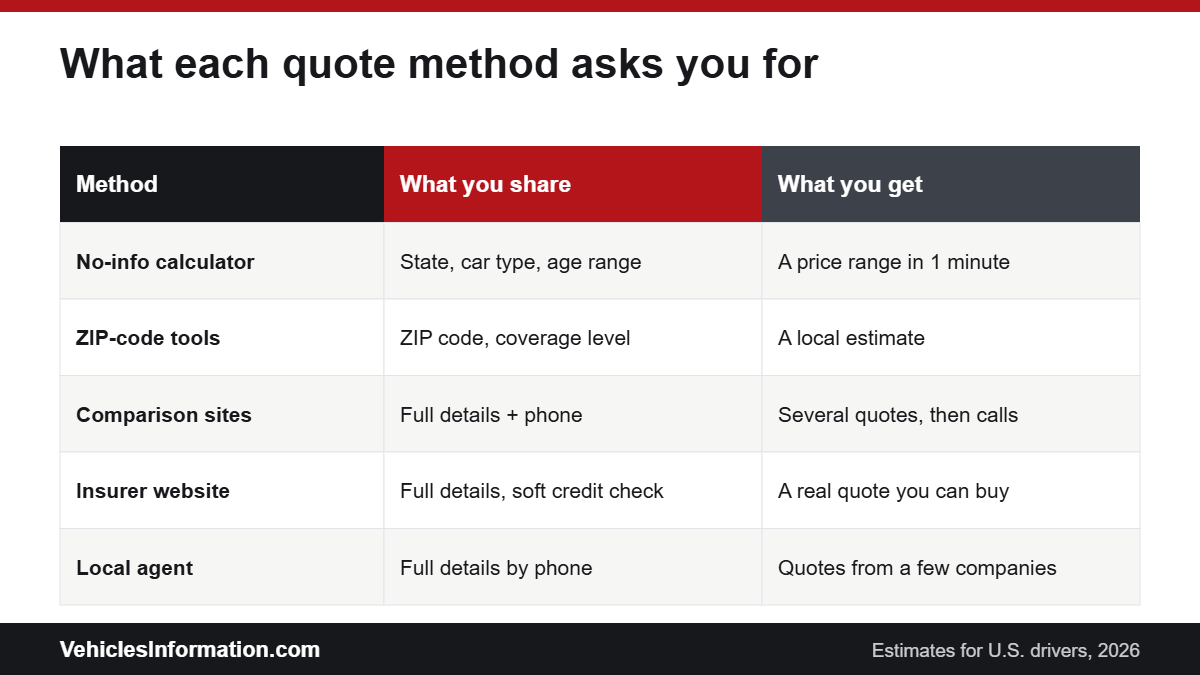
What each quote method asks you to share
Not every way of getting a price asks for the same information. Here’s what to expect before you start, so you can pick the method that matches how much you’re willing to share.
| Method | Personal info needed | Calls or emails after? | Accuracy |
|---|---|---|---|
| No-info calculator | None | No | Price range |
| ZIP-code estimate tool | ZIP code | Usually no | Local price range |
| Comparison site | Name, birth date, address, phone, email | Often yes | Close to real |
| Insurer website | Name, birth date, address, license, VIN | Sometimes | Exact |
| Local agent | Same as insurer, by phone or in person | Yes | Exact |
Why insurers ask for personal information
It feels nosy, but most of it is how pricing and fraud checks work. To sell you a real policy, an insurer needs:
- Name and date of birth to pull your motor vehicle report (MVR) and claims history (CLUE report).
- Home address because rates are set by ZIP code and garaging location.
- Driver’s license number to confirm your driving record.
- VIN for the exact car, its safety features and theft risk.
- Credit-based insurance score in most states. This is a soft check that does not affect your credit score.
What they don’t strictly need for a quote is a phone number you answer. An email for the quote and policy documents is enough for most direct insurers.
Does getting a car insurance quote hurt your credit score?
No. Insurers use a soft inquiry to build a credit-based insurance score. Soft inquiries don’t change your credit score, so you can collect quotes from as many companies as you like. If you live in California, Hawaii, Massachusetts or Michigan, credit isn’t used for car insurance pricing at all.
Can you buy car insurance online without talking to anyone?
Yes. Most large insurers let you quote, pick coverage, sign and pay entirely online or in their app, and you can print proof of insurance right away. You’ll still need to share the details listed above, but you don’t have to speak to an agent unless you want help.
State minimum, standard or full coverage: which do you need?
Your estimate changes a lot depending on how much protection you buy. Here’s what each level actually pays for:
| Coverage level | What it pays for | Who it suits |
|---|---|---|
| State minimum | Damage and injuries you cause to others, up to your state’s legal minimum | Older, low-value cars and tight budgets |
| Standard | Higher liability limits (often 100/300/100) plus uninsured motorist cover | Most drivers who own their car outright |
| Full coverage | Liability plus collision and comprehensive, which fix or replace your own car | Newer cars, and any car with a loan or lease |
If your car is financed or leased, your lender will almost always require full coverage. If you drive an older paid-off car that’s worth less than a few thousand dollars, liability with higher limits than the state minimum is often the better deal.
Local things that change your price
- Snow belt states (Minnesota, Michigan, upstate New York): more winter fender-benders push up collision costs. Winter tires won’t always earn a discount, but a clean record through winter does.
- Gulf Coast and Florida: hurricanes and flooding raise comprehensive premiums. Comprehensive is what pays if a storm surge floods your car in Houston or Tampa.
- Big cities: street parking in Chicago, Philadelphia or New York City means more theft and dings than a garage in a small town.
- Long commutes: drivers covering 60 miles a day around Dallas–Fort Worth or Atlanta pay more than someone who works from home in Vermont.
10 ways to lower your car insurance cost
- Compare at least three quotes with the same limits and deductibles.
- Raise your deductible to an amount you could pay tomorrow.
- Drop collision on an old car worth less than about ten times the yearly collision cost.
- Bundle car insurance with renters or home insurance.
- Ask about good-student, safe-driver and defensive-driving course discounts.
- Try a usage-based or pay-per-mile program if you drive little.
- Pay the full six-month premium instead of monthly installments.
- Keep your record clean. Tickets fall off after three to five years.
- Improve your credit if your state allows credit-based pricing.
- Re-shop every renewal and after life changes like a move or a new car.
Frequently asked questions
Is this car insurance calculator really free and anonymous?
Yes. It runs in your browser, doesn’t ask for a name, email, phone number or ZIP code, and doesn’t store your answers.
How accurate is an estimate without personal info?
It’s a reliable starting point. Most real quotes for a driver with the same profile land within the range shown, but your exact price depends on your record, address and the insurer.
Can I get a car insurance quote without a phone number?
You can get an estimate with no phone number at all. For a real quote, many insurer websites ask for one, but you can use a secondary number such as Google Voice, and going direct to the insurer avoids lead-generation calls.
Is there a car insurance comparison site that doesn’t require a phone number?
Some do, but many comparison sites are paid per lead and share your details with partners. Read the consent text before you submit. If it mentions partners or autodialed calls, expect calls.
How do I stop insurance calls after getting a quote?
Reply STOP to texts, ask each caller to put you on their internal do-not-call list, register at donotcall.gov, and report companies that ignore your request to the FTC.
Can I use a fake phone number to get a quote?
Don’t use a made-up number, because it may belong to someone else who will get the calls. Use a second number you control instead. Fake details can also make a real quote wrong or invalid.
How much is car insurance per month?
A typical adult driver with a clean record pays around $175 a month for full coverage in 2026, but state averages range from about $85 in New Hampshire to over $300 in Maryland.
Does getting a car insurance quote hurt my credit score?
No. Insurers use a soft credit check, which doesn’t affect your score.
Can I buy car insurance anonymously?
No. A real policy needs your name, address, date of birth and license details so the insurer can check your record and issue documents in your name.
Why is my car insurance so expensive?
Usually it’s a mix of where you live, your age, your driving record, the car you drive and your coverage choices. Run the calculator with different answers to see which one moves your price the most.

VehiclesInformation Editorial Team
The VehiclesInformation Editorial Team researches and writes our car and car insurance guides for U.S. drivers. Insurance figures are checked against state insurance department rules and published 2026 rate studies, and pages are updated when laws or rates change. Read how we estimate car insurance costs.